BRF board members currently have no easy way to see how their building sorts waste. We bridge that gap — turning Sortrace's raw camera data into dashboards, trends, and reports that any board can understand and act on.
Sortrace already equips waste collection trucks with AI-powered cameras that analyse how each household sorts its garbage. That raw data, however, never reaches BRF boards — the very people responsible for improving sorting in their buildings.
Sorting statistics exist but are presented as raw numbers and exports that board members have neither the time nor the tools to interpret meaningfully.
Without charts, trend lines, and material breakdowns, boards cannot see where sorting is failing, how it compares to previous periods, or which materials cause the most problems.
Preparing reports for board meetings and resident communication is time-consuming, done from scratch each time, with no standardised format or template to rely on.
Even when boards can see the numbers, they often lack practical advice on what to actually do about them — especially for the worst-performing materials and containers.
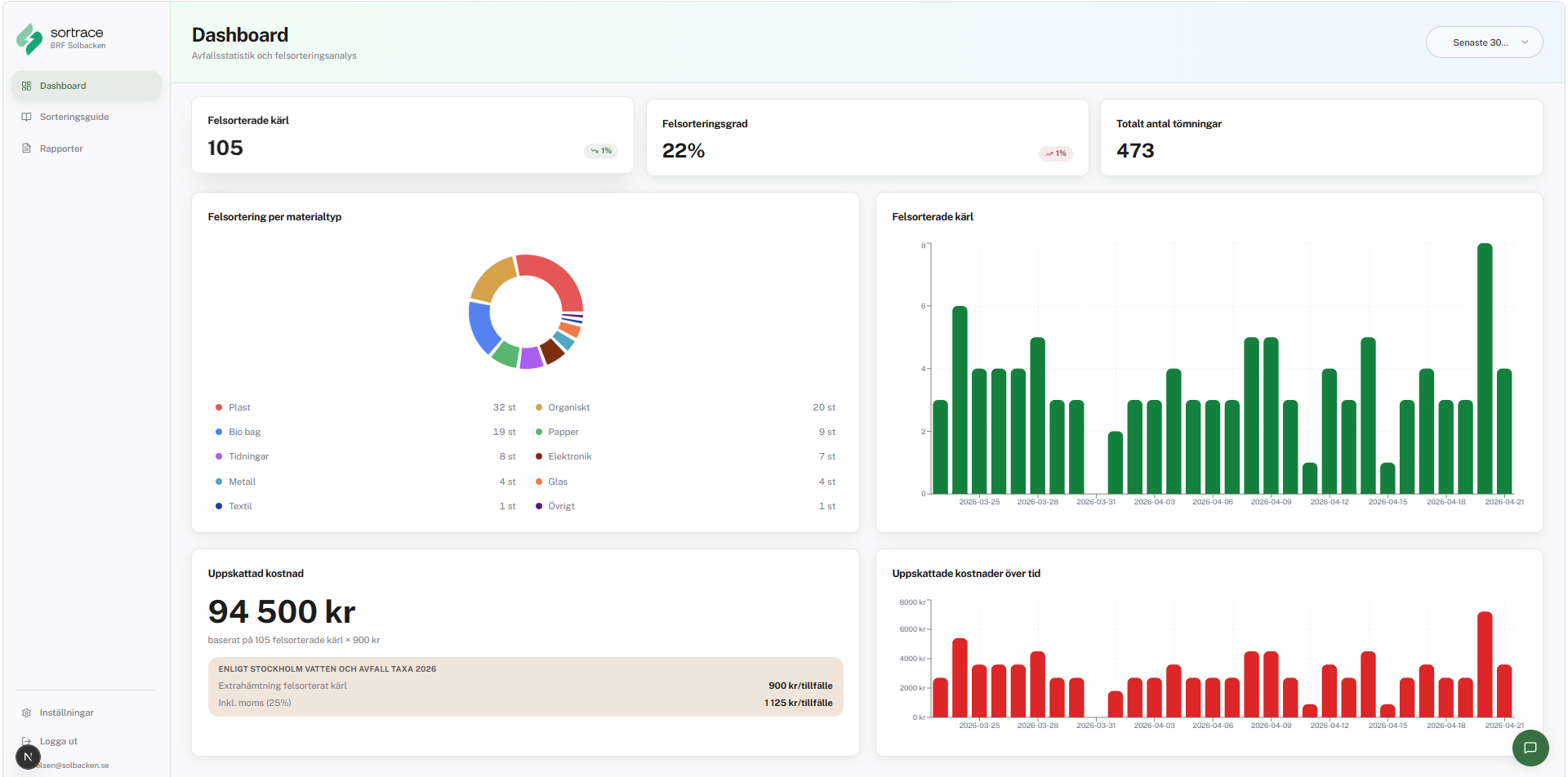
Our dashboard gives BRF boards an instant overview of their building's sorting performance — miss-sorting rate, total pickups analysed, material breakdowns, and estimated extra costs, all updated automatically and presented without any technical setup.
Trend charts show how sorting behaviour changes over time, and a material breakdown highlights exactly where problems occur — from plastic and food waste to paper and electronics. Each association sees only its own data through a secure login.
Board members sign in with email and password. Row-level security in the database ensures every association sees only its own data — fully GDPR compliant from day one.
Miss-sorting rate, total pickups analysed, trend lines over time, and a material breakdown — all at a glance. Filter by date range, material type, or container.
A built-in guide explains proper sorting per material type. The dashboard also surfaces personalised tips that highlight the specific materials where the BRF underperforms most.
Generate board-ready reports with KPIs, charts, and material breakdowns. Choose the time period — monthly, quarterly, or yearly — and export in one click, ready for the next board meeting.
Ask questions in plain language. The assistant is grounded in the BRF's actual sorting data and national sorting regulations, so answers are specific and actionable rather than generic.
The application is architected for real-world deployment. A data abstraction layer allows development against realistic seed data and a seamless swap to the live Sortrace API later without rewriting the application.
This application is developed as an external project in collaboration with Sortrace, a Swedish AI startup redefining how waste sorting data is collected and understood. The project is part of course II1305 at KTH Royal Institute of Technology, where Civil Engineering students in Information Technology design and build real software products together with industry partners. Our goal is to bridge the gap between data collection and data understanding — giving BRF boards the tools to make their buildings greener and more sustainable.
Have questions about the project, want to learn more, or are interested in a collaboration? Reach out to any member of Group Ersmark directly.